Raccoons are famous for getting into trash. Generally, they do this because they want to find a quick and easy meal. But what if a raccoon takes something out of the trash not because it wants to eat it, but because it wants to make something with it?
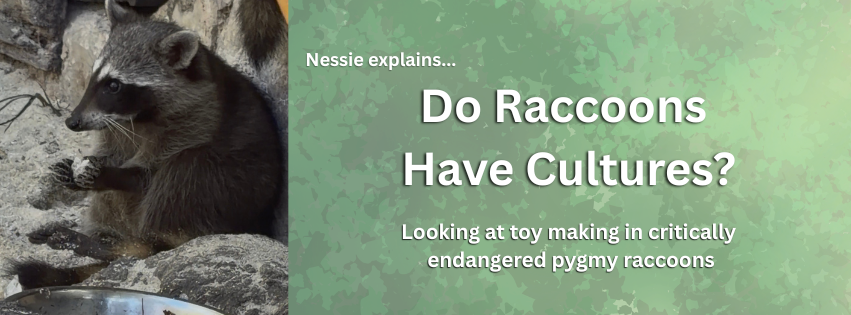
While I was studying critically endangered pygmy raccoons on Cozumel Island, Mexico, I watched two young raccoons do something I had never seen before. They took pieces of paper from a trash can, carried them over to a bowl of water, dipped them in, and then rolled and pressed the wet paper between their hands and against the sand until they had made little balls. Then they played with them. These raccoons had just made their own toys. One sister even appeared to learn how to do it by watching the other!
That observation eventually became my paper, Preliminary Evidence of Material Culture in the Critically Endangered Pygmy Raccoon (Procyon pygmaeus).
What Is a Pygmy Raccoon?
Pygmy raccoons (Procyon pygmaeus), also known as the Cozumel raccoon, are a critically endangered species of raccoon found only on the island of Cozumel, Mexico. They are a completely distinct species of raccoon from the common raccoon (Procyon lotor) found throughout the rest of North America. Despite the fact that there are less than 200 left on earth, we still know relatively little about their behavior.
What Is Material Culture?
Material culture refers to behaviors involving the creation, modification, or use of physical objects that are learned socially and can be passed between individuals. In animals, this can include traditions such as making or using objects in particular ways that others learn through observation. In humans, silly bandz from the early 2010s are a good example.
Right now, animal culture is most often discussed in relation to tool use. Chimpanzees use sticks to extract insects, and some dolphins use marine sponges while foraging, but material culture does not necessarily have to involve a tool that accomplishes some practical job. An object can also be part of play, social behavior, or another learned tradition.
This matters here because these pygmy raccoons were not making paper balls to get food, they were just making them to play with.
How did the pygmy raccoons make their toys?
During my fieldwork, I spent 64 hours observing pygmy raccoons at one tourism site on Cozumel. Two juvenile female raccoons, who were sisters, repeatedly collected paper materials such as receipts, napkins, and food wrappers.
The raccoons would take paper from a waste bin and bring it to a stainless-steel water bowl. They held the paper in their front paws, dipped it into the water, and then moved it onto the sandy ground. From there, they pressed, flipped, rolled, and compacted it with their paws. As they continued manipulating it, the wet paper picked up sand and gradually became more compact until it formed a ball-shaped object.
Afterward, the raccoons played with the balls. They batted them across the ground, chased them, rolled them between their paws, and sometimes interacted with the same ball together. Their mother joined in during some of the play, and in one instance two juvenile Cozumel dwarf coatis joined them as well.
How to make toys was a skill being shared between raccoon siblings
While a little paper ball is interesting by itself, lLearning how to make one from another raccoon is much more important scientifically.
One little raccoon was already able to perform the complete sequence. Her sister watched her, then went to the same trash can, retrieved paper herself, and tried to do the same thing. At first, she was not very good at it. Her early attempts failed or were incomplete. During one interaction, the more experienced sister actually took the paper from her and completed the process while the less experienced juvenile played with another finished ball nearby. The second raccoon had repeated opportunities to watch both the process and the finished result.
Unfortunately, the first pygmy raccoon then became ill due to complications from malnutrition and environmental pollution at the hands of a brand new beach club (not the one where this behavior was discovered, though) that had recently destroyed a large portion of their home territory, and was removed from the site for rehabilitative care where she later died. Several days later, I observed her sister successfully make a ball independently. She took a hamburger wrapper, brought it into contact with water, rolled it against sand and a rock, created a ball, and then played with it.
Why Does This Matter for Pygmy Raccoon Conservation?
When an endangered animal dies, we may lose more than its genes. We may also lose knowledge as well.
The first juvenile pygmy raccoon I observed making the paper balls later died while receiving rehabilitative care following malnutrition and exposure to pollutants. Other raccoons from the same family had also recently been lost. If this behavior really was being socially transmitted within the family, her death could have meant the loss of one of the individuals carrying that knowledge. Fortunately, her sister had apparently already learned the behavior.
Conservation often focuses on numbers: how many animals remain, how much habitat is left, and how genetically diverse the population is. Those questions are essential, but so is understanding behavioral diversity. Animals develop local knowledge about where to find food, what to avoid, how to interact with their environment, and potentially how to use or modify objects. Much of that information may be learned socially and passed between individuals.
For pygmy raccoons living alongside Cozumel’s gigantic tourism industry, that may be especially important. Young raccoons are growing up around trash cans, restaurants, tourists, roads, buildings, artificial food sources, and other human-created features. Some behaviors they learn may help them navigate that environment. Others may put them in danger.
And some may simply begin because a young raccoon discovers that if you put a receipt in water, roll it around in the sand, and smack it around with your little raccoon hands long enough, you can make yourself a ball and then you can play with the ball and that is fun.
For a species we still know remarkably little about, even a small observation like that can tell us something important.
Read the full journal article here